


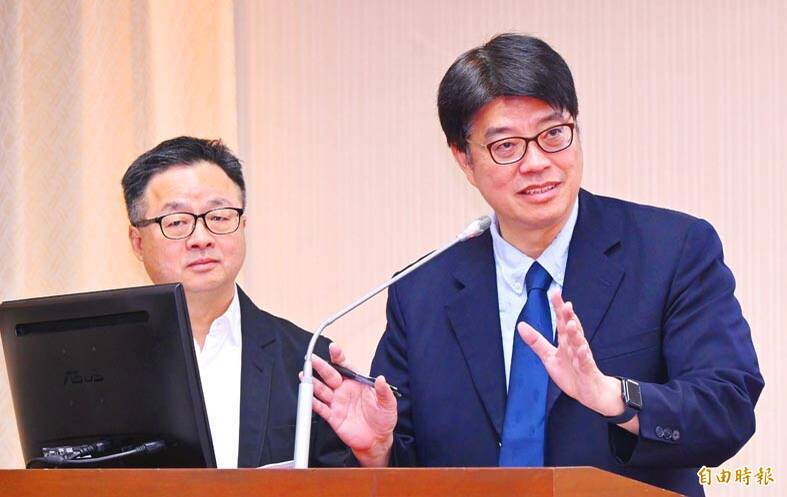
Mainland Affairs Council Minister Chiu Chui-cheng, right, and Straits Exchange Foundation Secretary-General Lo Wen-chia answer questions at the Legislative Yuan in Taipei yesterday.
Photo: Liu Hsin-de, Taipei Times
RELIGIOUS GROUNDS:Followers of the I-Kuan Tao are especially advised not to travel to China, following a 50 percent surge in religious detentions in three months
By Chen Yu-fu / Staff reporter
Nineteen people have been detained in China in the past three months because of their religious beliefs, representing a 50 percent surge from the previous three months, Straits Exchange Foundation Secretary-General Lo Wen-chia (羅文嘉) said yesterday.
The Legislative Yuan’s Internal Administration Committee invited the foundation, Mainland Affairs Council (MAC) and other agencies to deliver a report on the government’s response to the growing number of missing Taiwanese citizens in China.
From Jan. 1, 2024, to Wednesday last week, 402 people have gone missing, been detained for questioning or imprisoned in China, MAC data showed.
Of the total cases, 154 are missing, 32 have been detained for questioning and 216 have been imprisoned, the council said.
Among the 216 imprisoned, 134 people were arrested for fraud, 58 people were arrested for other criminal offenses, 23 people were arrested on religious grounds and one person over national security concerns, it said.
Although the council’s travel alert for China is “orange,” Lo said that in his view it should be a “red alert,” and he especially advised followers of I-Kuan Tao (一貫道) to avoid traveling there.
Democratic Progressive Party (DPP) Legislator Wang Mei-hui (王美惠) said that she had reported a missing person case to the council months ago, but its only reply was that official cross-strait communications had been suspended.
MAC Minister Chiu Chui-cheng (邱垂正) said that the council would assist with the cases and would not leave families without recourse.
Over the past year and a half, the foundation has received 225 reports of people going missing in China, of which 91 — or 40 percent — could not be contacted, Lo said.
The 19 detentions over the past three months because of religious beliefs represent a 50 percent surge, Lo said.
Those arrested include businesspeople who have operated in China long-term, tourists and those engaged in cultural exchanges, he said.
There are also cases not included in the 19 in which families did not seek help, but the foundation learned about them independently, such as the arrest of a Taiwanese who had taught in China long-term, he said.
The foundation has repeatedly reminded I-Kuan Tao followers not to travel to China over the past two years, but missing person cases involving the group have continued to surge, he said.
According to a 1990 cross-strait crime-fighting agreement, when a Taiwanese traveler is detained, immediate notification should be provided, but since 2024, China has notified Taiwanese authorities on a selective basis, Lo said.
He expressed hope that Beijing would implement notification in accordance with the agreement, and urged people to avoid going to China if possible.
Asked by DPP Legislator Chang Hung-lu (張宏陸) exactly how many people are detained in China, Chiu said that 216 people have been detained by Beijing over the past two years, increasing by about 16 to 18 cases each month, all of which were reported by their families.
Chinese Nationalist Party (KMT) Legislator Liao Hsien-hsiang (廖先翔) said that the family of the person detained over national security concerns has been accusing the MAC of being a mouthpiece for the DPP administration’s anti-China agenda.
The MAC has a responsibility to inform people of the risks of traveling to China, Chiu said, adding that the council could not comment publicly on the single national security case due to the family’s request.
Asked by Liao if the council has received any reports of people having their organs harvested in China as rumors have claimed, Chiu said it had not.
Additional reporting by CNA
新聞來源:TAIPEI TIMES














Leave a Reply